Tag: Conflicts

  • Stakeholders Identify Causes Of Insecurity

    Stakeholders Identify Causes Of Insecurity

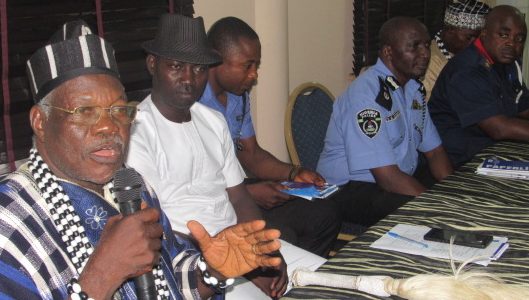
    Unemployment, farmers-herders conflicts, cultism, control and ownership of markets and motor parks are part of the causes of insecurity across the country, stakeholders in security sector, have observed.

    Some stakeholders, security experts and members of Civil Society Organisations, identified these during the security meeting organised by Cleen Foundation with the theme: “Emerging Security Challenges in the South-West” on Thursday.

    The stakeholders proffered various solutions to the security challenges in a stakeholders engagement held via Zoom.

    Mr. Okechukwu Nwanguma, Executive-Director, Rule of Law and Accountability Advocacy Centre, said that “there is need for government to address the socio-economic root cause and other risk factors of crime.”

    Nwanguma said that the government should also ensure social justice and equity as well as the monitoring and prosecution of corrupt practices offenders, especially those in the security sector.

    “It would help reduce crime rate knowing that there is consequences for crimes and create a more enabling environment for businesses to thrive and for tourism activities to blossom.

    “Also, the use of state violence and repressive law enforcement approaches and the clamp down on citizens exercising their constitutional rights to freedom of expression should also be looked into,” he said.

    Mr. Bukola Idowu, a security stakeholder, said that communal clashes, impunity by cyber criminals, as well as religious intolerance, are also factors responsible for threat of security.

    He called on the government to address the issue of resource control and also an urgent reform of the police as well as the judicial system with the view of restructuring both agencies for an effective service delivery.

    READ ALSO:Afghanistan Exit Among ‘Worst Foreign Policy Decisions’ Ever – Senate Republican Leader

    Mr. Tosin Osasuna, also a security expert, suggested that improved conflict resolution mechanism, active promotion of community engagements and effective policing of communities and massive investment in socio-economic development were steps to reduce crime.

    Mrs Rita Ilevbare, a security analyst, said that state government in both the southwest and north eastern region should allow unrestricted access to information on their day-to-day dealings in view of the Freedom of Information.

    She said this would broaden their social security schemes to include the youths who constitute a larger percentage of unemployed persons in the region and reduce speculation on financial misappropriation and other financial crimes.

    She urged Nigerians to become security watch dogs and provide the authorised security agencies with relevant information when necessary.

    Ilevbare said that although it was the duty of the government to tackle insecurity and lead good governance, however, citizens must complement the effort of government by collaborating and supporting government to attain peace and good governance.

    She urged religious leaders, traditional rulers and patrons, heads of social, political and non-political groups, parents and guidance to guide, direct and lead their followers appropriately for the benefit of the entire society.(NAN)

  • Herder/Farmer Conflicts: Objective Reportage, Panacea To National Peace, Unity

    Herder/Farmer Conflicts: Objective Reportage, Panacea To National Peace, Unity

    The Executive Secretary Teaching Service Board, TSB, Makurdi, Mr. Wilfred Uji, has tasked journalists on objective reportage of the various conflicts in Nigeria as a panacea to national peace, unity and development.

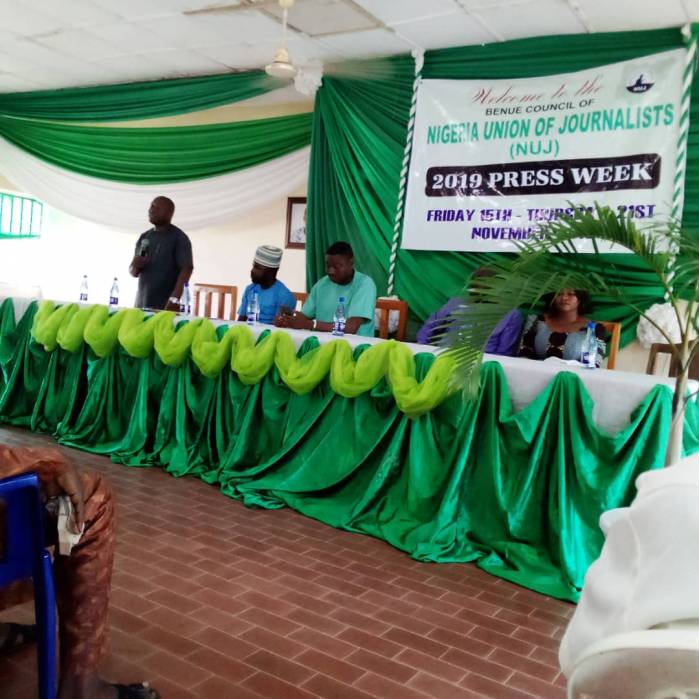
    Uji, who was Guest Speaker at the NUJ 2019 Press Week, which held at NUJ House Makurdi, the Benue State capital, said he views objective reportage as putting national cohesion, unity and development ahead of sensation.

    Speaking on the theme: “Ending Insecurity In Nigeria Via Objective And Accurate Reportage” Uji called on journalists to be objective and factual at all times saying objective reportage in ending insecurity means reporting the security challenges confronting Nigeria on the basis of facts, analysis and investigations.

    Uji, who blamed the West for the precarious security situation in Africa and Nigeria in particular, urged journalists to be courageous, pan African and not further promote the ideology of the West in presenting the continent as a land of impossibilities.

    “To me the important thing is not just reporting; it is about achieving national development, unity and cohesion, with ideological trust,” he said.

    He however, said facts alone do not make news; rather it is the interraction between the journalist and his facts.

    Balancing the facts with the environment, according to the TSB boss is what makes news objective, which will ultimately free the people from insecurity.

    He identified six steps to achieving objective reportage to include establishing research centres for practicing journalists, establishment and application of ICT facilities in information sourcing, reporting from the pan Africanist perspective, that is being positive about Africa.

    He also said journalists must network with security agents, politicians and must learn to love and respect themselves and promote ethical standards to achieving objective and accurate reportage.

    READ ALSO: Herder/Farmer Conflicts: HD’s Town Hall Seeks Peace Among Benue Communities

    “Of course, journalists need help. However, the only way to be objective in the face of all of this is to reject certain offers. Love yourselves more, sit together and appreciate yourselves and you will do better and that way, you will maintain your self respect, dignity and also earn the trust of the people,” Uji said.

    He nevertheless, admitted that “reporting on security issues is delicate and challenging. The only way to report is to be armed with facts,” adding that reporters must also arm themselves with the knowledge of who owns what, for who and for what purpose.

    The event also witnessed the renaming of NUJ Hall as David Ukuma Hall, in memory of the deceased former NUJ Chairman Benue State Council, who died less than a year in office.

    Benue North East Senator Dr. Gabriel Suswam, appreciated the council for dedicating the hall in memoriam of one of his constituents, David Ukuma.

    Suswam, who was represented by his Media Aide, Bede Bartholomew, acknowledged his cordial relationship with the erstwhile Chairman, while alive. He also thanked members of the council for the support he has been enjoying from them in the course of his service to the state and country.

    The Ukum LGC Chairman Iberlogo TorTyolyaa, also spoke warmly of Ukuma, as a hardworking, dedicated professional who was committed to the dictates of his profession.

    TorTyokyaa, who was represented by the immediate past President of Media intellectuals’ Union, Jerry Iorngaghem, also thanked the council for honouring Ukuma.

    Earlier in her remarks, the State Council Chairman of NUJ, Mrs. Victoria Asher, said the essense of the press week is to enable members of the union to unwind.

    “It is also an opportunity to interract and share experiences,” the Chairman said, while urging Benue journalists to celebrate themselves because “they are the best.”

  • PWDs Suffer Most From  Conflicts – Iorkighir

    PWDs Suffer Most From Conflicts – Iorkighir

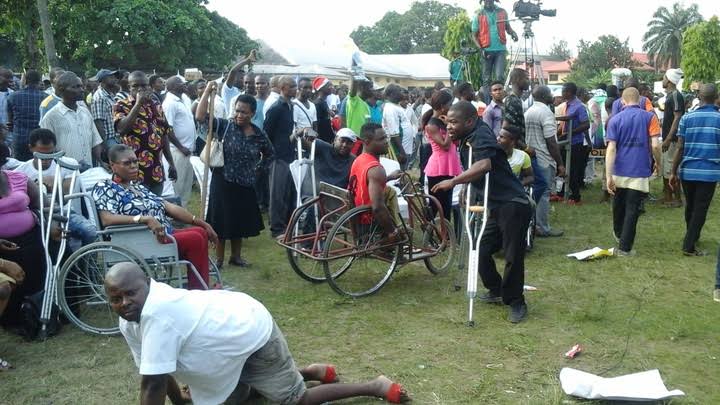
    The Chairman of Joint Natonal Association of Persons With Disabilities, JNAPWD, in Benue State, Mr. Peter Iorkighir has said that People with Disabilities, PWDs, were the worst hit in all the security challenges that had confronted the state.

    Mr. Iorkighir, who stated this while speaking to our correspondent in Makurdi, emphasized the need to give peace a chance for the progress of the state and wellbeibg of all citizens.

    The chairman said it had become necessary to call attention to the plight of PWDs in the state.

    Iorkighir noted that while the herder/farmer conflicts raged in the state, persons with disability suffered most as according to him, “when an incident occurs, they cannot help themselves or run like others because some of them are blind, some are crippled while some are deaf.

    “So people always run and abandon them to fall victims to the crisis. So that is the major challenge.”

    He said PWDs were special people with special needs, especially funds to assist themselves.

    Mr. Iorkighir, who identified feeding and accomodation for members as one of their major challenges, said most of their members had been abandoned to their fate and now lived in IDP camps while the association had to make private arrangements to accommodate some others pending when the problem would be resolved.

    He stated that the association was totally exhausted and call on governments to ensure peace and adequate security in the state so that people could go back to their homes and to their normal lives.

    He noted that in camps where some of their members now resided, food and other luxury items were not usually enough hence only those who are strong and can struggle for them get to have them most times.

    “We now depend on family members to feed. Most of us had our businesses; some of us were into poultry others into fishery but we cannot continue because our houses are burnt down because of the crisis.”

    He appealed to the government, Non -Governmental Organizations, NGOs and private organizations to offer their members employment saying “Some of us have been to higher institutions and have the qualifications.

    “Even if there is no employment, there should be empowerment so that we can earn a living. Government should carry us along in their programmes. We should not be left out to suffer the way it is now,” he said.

    A camp coordinator at Abagana IDP camp, Mr. James Iorkyaa told our correspondent that about 300 persons with various forms of disabilities, live in Abagana camp alone.

    Iorkyaa expressed concerns over the prevailing situation in the camp, and appealed to the federal government and other stakeholders to ensure that peace returned to enable IDPs, particularly, PWDs who are worst hit to return to their homes.

    He commended the effort of civil societies organizations, local and international NGOs, governments and good spirited indidviduals in catering for the needs of the displaced persons urging them to do more.

  • Herders-farmers Conflicts: Miyetti Allah Calls for Collaboration Among Religious Leaders

    Herders-farmers Conflicts: Miyetti Allah Calls for Collaboration Among Religious Leaders

    The leaders of Miyetti Allah Cattle Breeders Association of Nigeria, MACBAN, have said should collaborate to unite the various religious groups in the country and for peaceful resolution of the farmers-herders’ conflicts.

    MACBAN’s National Secretary, Baba Ngelzarma, made the call on Wednesday during a courtesy visit by a delegation of the association to the national leadership of Christian Association of Nigeria, CAN, in Abuja.

    He solicited for support for “all government initiatives toward solving the farmers-herders conflicts.”

    He said: “MACBAN wishes to request the partnership of CAN in uniting the different religious groups in the country for peaceful resolution of the farmers-herders conflicts.

    “We should unite against hatred and support all government initiatives toward solving the conflict.

    “We believe the 10 years plan will guarantee efficient time for pastoralists to learn new techniques of Livestock production.

    “MACBAN will require that government implements the plan as designed in order to assist the pastoralists through proper extension services and training over the plan period to properly learn how to manage livestock efficiently.

    “Both MACBAN and the umbrella body of farmers, AFAN, benefited in training organised by the Presidency on peace-building and conflict resolution.

    “We seek the cooperation of CAN to be part of our National Campaign to reorient our youth to fear the Almighty, inculcate values of handiwork, empathy and being our brothers keeper irrespective of their faith.

    “Like all other communities we have our bad eggs and we have not relented in fishing them out all across the country.

    “We have been to Ebonyi, Ekiti, Enugu, Katsina, Oyo and now Zamfara to assist in resolving conflicts with our members.

    “We are grateful for the level of understanding and cooperation we have received from the state governments in resolving some of these security issues.”

    Responding, the National Chairman of CAN, Rev. Supo Ayokunle, assured his guests that CAN will look into their proposal.

    He called for prayers for the country noting that “the devil was at working” making Nigerians to fight each other.

    “I will urge all of us to be prayerful because I see the devil at work, provoking men to do things that are very odd, things that for years ago you cannot think can happen in Nigeria.

    “Devil is at work and it will make us to be fighting ourselves. If we are not careful we will not be able to chase him out.

    “It is with our collectivity that we can chase the devil away.

    “We have received your move with appreciation, we will sit down and articulate it to be well informed on all these proposals you have raised,” the CAN President said.

  • Oil Sanctions: OPEC Seeks Quick Resolution of U.S.,  Iran, Venezuela Conflicts

    Oil Sanctions: OPEC Seeks Quick Resolution of U.S., Iran, Venezuela Conflicts

    The Organisation of the Petroleum Exporting Countries (OPEC) has stressed the need for a quick resolution of the conflicts between the U.S., Venezuela and Iran.

    Following geopolitical conflicts, the U.S. has placed sanctions on Iran and Venezuela, who are both founding members of OPEC.

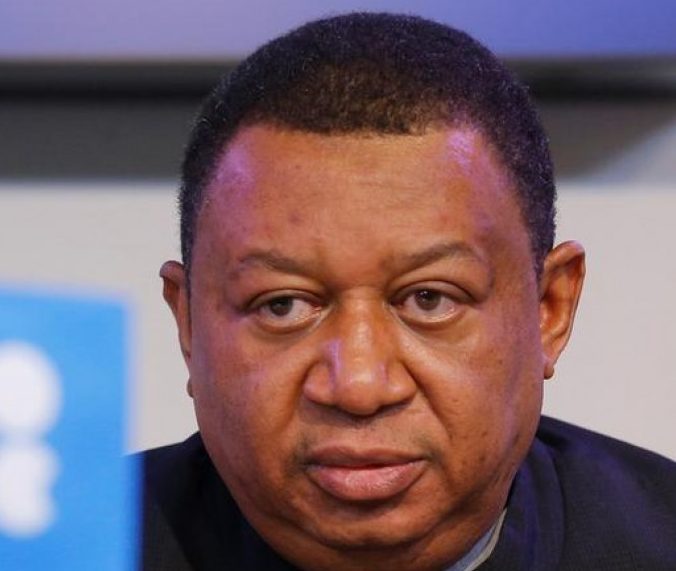
    Secretary General of OPEC, Mr. Mohammad Barkindo, told newsmen in Vienna that the affected countries would remain exempted from the implementation of the oil supply adjustment of 1.2 million barrels a day – owing to their situation.

    “We decided that because of the situation confronting these two countries and the effects of the sanctions and how it will affect their production, together with Libya, they will remain exempted.

    “For us we will welcome a resolution of the issues that are at stake between these countries and the US. Sanctions distort markets and further complicates our efforts with non OPEC members to maintain stability.

    “These geopolitical tension are inimical to stability across the world and we look forward to world leaders to continue to do their best to ensure that conflicts on trade and military are avoided.

    “The world needs peace and stability to ensure growth and development,” he said.
    OPEC and oil producing non-OPEC members at the just concluded 176th Conference also agreed to extend production caps by nine months.

    These caps have seen some oil prices rise by as much as 25 percent this year, and has now be extended until March 2020.

    Barkindo, who was re-elected at the Conference for another three-year term applauded the “Declaration of Cooperation” between the bloc and its oil producing non-members and described it as a key factor in stabilizing the oil market and ridding it of volatility and uncertainty.

    According to him, since the cooperation became effective in 2016, the economies of member countries have responded positively.

    “To go forward we agreed to further institutionalize the partnership so that it will be a permanent feature in the energy landscape and hence the adoption of a Charter of Cooperation which provides us with a permanent platform of working together,” he said.
    He said that Nigeria and other countries had signed the charter, but urged them to also ratify the document.

    News Agency of Nigeria , NAN, reports that the Charter will serve as a voluntary platform that brings together producers on board across the policy and technical levels in a bid to continue to address all the challenges of the oil market and the energy landscape.

    NAN

  • Conflicts: Search Restoring Peace to Benue Through Peace Architecture Dialogue

    Conflicts: Search Restoring Peace to Benue Through Peace Architecture Dialogue

    The Third Peace Architecture Dialogue, PAD, meeting in Benue has ended with stakeholders calling on all and sundry to support the full implementation of the Benue Anti Open Grazing and Ranches Establishment Law as a panacea to possible return of peace in all communities of Benue State.

    Also, the need for government to create jobs for the growing population of youths in the country so as to curtail youth restiveness and their involvement in cultism and other sundry crimes in the society was advocated.

    The PAD meeting was organized by Search for Common Ground, an NGO funded by the Kingdom of Netherlands towards “Transforming the Herder/Farmer Conflict and Promoting the Freedom of Religion and Belief in Nigeria’s Middle Belt”.

    The meeting brought together stakeholders including members of Miyethi Allah Cattle Breeders Association of Nigeria, MACBAN, led by their chairman, Zakari Mohammed, representative of Benue State Planning Commission, BSPC, Mrs, Nambativ Helen, the Benue State Vigilante Group, Dr. Daniel Bo, AFAN and others who pledged their commitment to the peace initiatives.

    The Permanent Secretary, Ministry of Information and Orientation, James Agbo, observed that if the Benue people’s open grazing prohibition law is faithfully obeyed as being implemented, peace will be inevitable in the state.

    Mr. Agbo encouraged the police and other security agencies to wake up to their responsibilities of ensuring that laws of the land are respected by all inhabitants, even as he urged ‘Search’ to take the sensitization to the rural areas.

    The Ter Makurdi, Sule Abenga implored NGOs such as Search and other peace advocates to adopt the Anti Open Grazing and Ranches Establishment Law as a stand point to their peace crusade in Benue.

    He expressed belief that NGOs and Civil Society Organizations, CSOs, can help sensitize the people and concerned agencies towards advancing peace in the society.

    READ ALSO: Five Persons Killed In Fresh Attack in Benue

    He assured of the cooperation of the traditional institution at ensuring that the NGO records success in their set goals.

    Also speaking, the Commissioner of Police, Benue State. CP Mukaddas Garba noted that for peace to be achieved, the causes of crisis must be identified and tackled.

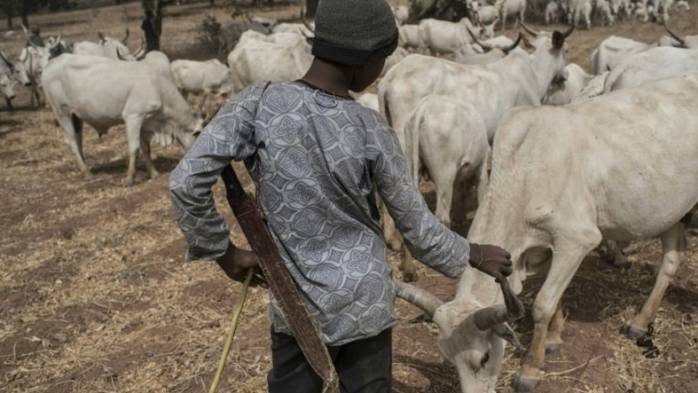
    The Commissioner who was represented by the DCP. Ibrahim Zakari, identified some of the causes to include increase in the country’s population, use of children as herders instead of experienced adults, encroachment and destruction of farms and crops, rustling among others.

    He said the police have taken proactive measures, high visibility policing, patrols, stop and search and intelligence gathering to surmount the challenges.

    Earlier, the State Project Coordinator for Search for Common Ground, Mr. Chorbe Joshua appreciated
    participants for reconvening for the meeting saying their various contributions at ensuring the possible return of peace and the resolutions met at the meeting will enhance the next action plan of the organization.

    Chorbe reiterated the role of the stakeholders towards the realization of sustainable peace in Benue state and urged the participants to synergise more across the different sectors; government, security agencies, traditional rulers, NGOs and CSOs, religious and community leaders, youth and women associations, persons with disability and Community and Security Architecture Dialogue, CSAD members.

    “This will be a more appropriate avenue to exchange ideas and jointly develop action plans that would address issues faced in the communities.”

    He further stressed the importance of linking the CSAD issues to the PAD platform for more experts’ contributions and recommendation in resolving the herders/farmers conflict. He also sought for more collaboration across all structures on early warning response in Benue state.

  • Conflicts: Search Brings Farmers, Herders to the Dialogue Table

    Conflicts: Search Brings Farmers, Herders to the Dialogue Table

    Over the years, in most parts of the country, herders and farmers have been at dagger drawn over land; for grazing and agricultural purposes. In Benue, the situation is not different. Despite concerted government efforts, conflict between livestock and crop farmers has continued unabated with both parties incurring unquantifiable loses in both human lives and properties.

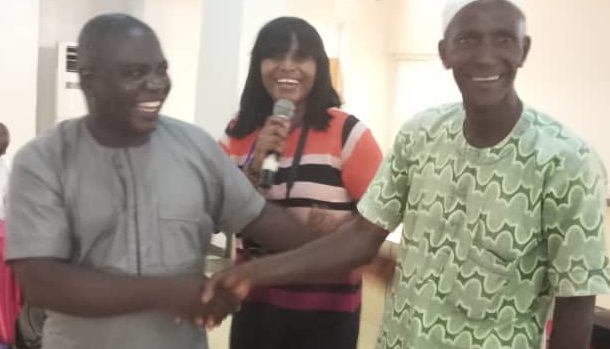
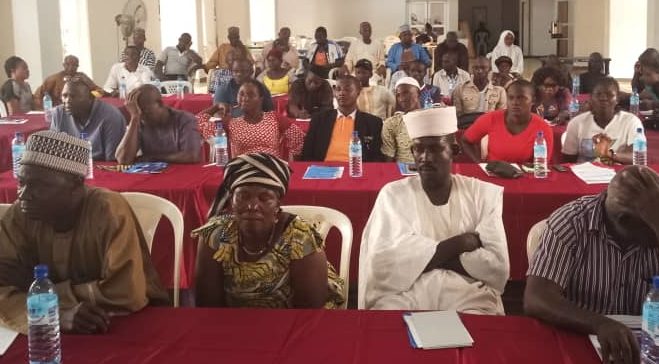
    In its continuous efforts to ensure peaceful coexistence between farmers and herders in Benue state, Search For Common Ground, a Non Governmental Organisation, NGO, recently brought the two parties to the discussion table.

    The meeting was an inter dialogue forum which brought together farmers and herders from Guma Local Government Area of the state.

    The inter dialogue meeting also had in attendance distinct groups; traditional rulers, the clergy, Civil Society Organisations, representatives of government among others.

    The aim of the meeting was to dialogue, highlight key conflict issues faced by the groups, address and analyse them and develop joint solutions to prevent violence not only in Guma, but in other parts of the state ravaged by the crisis.

    The farmers and herders numbering over 70 who were present at the discussion table expressed joy at the peace initiative describing it as a welcome development. They said living in Benue state over years, their families have shared same facilities like schools, markets as well as hospitals and boarded same vehicles among others, hence the need for peace.

    They agreed that there was need for peace among them stating that the crisis between them have always been fuelled by unscrupulous elements among them.

    Speaking at the meeting, both farmers and herders identified major causes of the conflicts.

    While the herders said rustling and killing of their cattle by farmers was the major cause of the conflict, they also accused security operatives of taking sides with the farmers and threatening to kill their cattle without any reason.

    The herders further blamed inadequate awareness and alternatives for herders before the anti-open grazing law, lack of patience and tolerance on both sides as well as lack of trust as reasons for the crisis.
    Conflicts: Search Brings Farmers, Herders to the Dialogue Table

    The herder group also complained that farmers have treated them like second class citizens because they believed that they (farmers) were more educated so they take the herders for-granted and whenever there was a conflict between them, they report herders to security operatives.

    On their part, farmers claimed it was lack of unity, oneness, unforgiveness and shared bitterness of the past and wrong method or approaches in conflict handling.

    The farmers also had other complaints which included that the headers have carried out unprecedented violence across the state killing more farmers especially in Mbabai, Cambe and other Communities in Guma LGA.

    The farmers also lamented wanton destruction of farm products/inputs and crops by herders, rape, displacement of people and continuous fear of going to the farm.

    ‘Our children cannot go to school because of fear of being killed. There is hunger and poverty across all the affected communities. In Mbadwen community in particular, there is destruction of schools, clinics and churches by herders.

    They also named misinterpretation of information as contained in the anti open grazing law, climate change, negative inducement by external factor and politicians, inclusion of foreign herders into the community, Bokoloji and language barriers as part of the challenges.

    READ ALSO: Ekiti Herders’ Killings: Joint Security Team Arrests 2 Suspects

    However, at the end of the meeting, both parties recommended that farmers and herders should provide platforms for addressing the identified issues.

    The herders who urged government to look into the anti-open grazing law by reviewing it, called for inclusive governance, good leadership and a robust justice system.

    They also appealed to government to provide them space to graze their cattle in Guma LGA.

    The herders said there should be trust and confidence between farmers and herders to strengthen peaceful relationship. “We should always accept our faults when wrong and apologize when necessary because without peace the nation cannot move forward. Parents and youths should come together and live in peace and harmony by bringing up the children properly and letting them know that peace is paramount and has no alternative,” they said.


    Farmers particularly recommended that stakeholders from both parties (Farmer & Herders) should organize a community dialogue to sensitize their people and proffer solutions that would bring about peace. “Media and security agencies should be involved during the meetings for safety,” they also said.

    They called for establishment of ranches across the state and not just in the state capital alone and cautioned that herders should not destroy their farms or crops.

    They cautioned the youths to desist from cattle rustling and called for consistent dialogue, positive negotiation, constant enlightenment and training of community stakeholders to forestall future occurrences.

    Speaking to The Next Edition after the meeting, a participant and Chairman of Security Architecture for Dialogue in Guma LG, Rev.Justine Sukwa said the meeting was a welcomed development.

    He said both parties needed to come to a discussion table to shift grounds for the sake of peace, “so we appreciate Search a lot for this.”

    Rev. Sukwa who is also the chairman of Christian Association of Nigeria, CAN in Guma LGA said the clergy in conjunction with other civil societies have carried out sensitization in the local government to ensure that all hands were on deck for the return of peace in Benue.

    Special Assistant to Governor Samuel Ortom on Herdsmen, Shehu Tambaya also commended Search for summoning the meeting, saying it would compliment government’s efforts at bringing lasting peace to the state.

    Tambaya, who advised both the herders and farmers to embrace peace, urged the herders to always point out and report the strangers among them. He assured them that the Ortom led government was doing everything humanly possible to ensure the peaceful coexistence of all the people living in Benue.
    Conflicts: Search Brings Farmers, Herders to the Dialogue Table

    The Senior Program Manager, Mrs Olutoyin Falade and the State Project Coordinator for Search, Chorbe Joshua expressed happiness that the interaction brought about a lot of changed in perception leading to shifting of grounds. They said both parties have been urged to protect each other’s interest and have understood that peace was the utmost.

    While some farmers and herders expressed joy for sitting together to discuss the way forward, Falade said she was confident that the dialogue would lead to permanent resolution of the conflicts.
  • Media Charged To Reduce Incidences of Farmers, Herders Conflicts With Their Reportage

    Media Charged To Reduce Incidences of Farmers, Herders Conflicts With Their Reportage

    A Non Governmental Organization, Search for Common Ground, (Search) has the media to change the narratives and framing of the farmers/herders crisis for the peace and security of all citizens.

    Speaking at a one day conflict sensitivity media roundtable organized for media chiefs in Makurdi, Benue state capital, Executive Director, Africa Centre for Corporate Responsibilities, Mr. Onuoha Austin said the media are critical stakeholders in maintaining peace in any society.

    Presenting a paper on “Farmer and Herder Conflicts, Policy Option and Roles of the Media,” Onuoha, also described the media as a veritable tool to reducing incidences of farmers/herders crisis and urged journalists to be more creative with their stories.

    He said the media must go beyond the traditional practice of breaking the news to inform and produce stories written and targeted at proffering solutions to the farmers/herders conflicts and other issues in the society.

    Onuoha, who observed that the farmer/herder crisis has escalated in most cases because of the reports churned out by some journalist in their attempt to break news, sell their papers and score some points urged journalists to rather draw attention of authorities to end the crisis.

    READ ALSO: Gov. El-Rufai Directs All Political Appointees to Resign

    “Journalism practice has evolved over the years and your stories must elicit assistance on finding common grounds to end the crisis when they arise.

    “Media reports should set agenda for relevant establishments to put up accessible redress mechanisms for those affected in the crisis,” he said.

    He further suggested that the media should avoid dwelling on conflict theories but practice transformative journalism with reports centred on economy, security, governance, developments, common grounds and positive citizenship initiatives that can better affect the lives of citizens.

    Stakeholders at the event also suggested continuous advocacy visits and sensitization of all parties as panacea to solving the problems.

    Chairman of the Nigeria Union of Journalists, (NUJ) Benue State Council, Mrs Victoria Ashar thanked the organization for building the capacity of journalists on conflict sensitivity and pledged media collaboration for lasting peace.

  • Farmer-Herder Conflicts: Search Dialogues with Stakeholders for Lasting Peace

    Farmer-Herder Conflicts: Search Dialogues with Stakeholders for Lasting Peace

    A non-profit organization, Search for Common Grounds, Search, has called for collaboration among stakeholders in finding lasting peace in Benue state.
    The NGO, which organised  a Peace Architecture Dialogue, PAD,  in the state recently, lamented that Benue state was most hit by the herder-farmers conflicts, hence the need to find lasting peace.

    State Project Coordinator for Search, Chorbe Joshua, while addressing participants at the PAD inaugural meeting said the dialogue, holding in Benue State for the first time was aimed at  deepening stakeholders engagement in dealing with peace and security issues in the State.

    According to him, PAD would be supported by Search for a period of 12 months.
     on the values of Search as humility, humanity, empathy and audacity as a major driving force of the organization which has been maintaining the pace at all level.

    Mr Chorbe said the project was already running in Guma and Otukpo Local governments and hoped to extend to other local governments affected by the conflict including Logo, Agatu and Makurdi.

    Giving an overview of the project, Senior Project Manager for Search, Olutoyin Falade  regretted that the state since the crisis between farmers and herders has witnessed wide scale  human right abuses and increase in crimes such as cultism, drugs abuse, robbery, habouring of criminals by natives while increase in number of IDPs and IDPs camps have also been noticed.

    She said Search aim  was to find ways to bring already divided relationships back to normal with a peace architecture dialogue at the state level and community security architecture dialogue at the local government levels.

    Falade who said Search will be building on the existing peace structures in the state, expressed hope that at the end of the project, peace would return to Benue for her development and the development of the country at large.

    The participants at the meeting; SA to Governor Samuel Ortom on SDGs and NEPAD, Dr. Magdalene Dura, represented by Beatrice Shomkey, SA on Development and Cooperation, Commissioners for Agriculture and Information, Hycinth Nyakuma and Joseph Shimaor among others commended Search for bringing such a laudable project to Benue and expressed commitment to work with them.

    Commissioner of Police in Benue state, CP Omololu Bishi said the force was overstretched  in carrying out its constitutional responsibility in maintaining peace, law and order.

    Bishi, represented by the Deputy Commissioner in-charge of Operations, DC Bumi Osoko said “It gives us concerns when these clashes occur and people are killed. We want to be part of your programmes as it will also enable us carry out our responsibilities.”

    Commissioner for Information in the state, Mr Joseph Shimaor who insisted that government was about protection of lives and property said the Ortom led government would work with partners to restore peace for development in the state.

    READ ALSO: NDDC Trains 28 Physically Challenged Persons in Edo

    Our correspondent reports that Search for Common Grounds,  is an international non-profit organization  that promotes peaceful resolution of conflict, with headquarters in Washington DC and European office in Brussels, Belgium.

    Search has a mission to transform how individuals, organizations and governments deal with conflict away from adversarial approaches and towards cooperative solutions.

    The organization is implementing a 24 months projects titled, “Transforming the Herder-Farmer Conflict and Promoting Freedom of Religions and Belief in Nigeria’s Middle Belt.”

    The project aims to increase collaboration between herder and farmer communities to develop joint, effective sustainable local mechanism for early warning, early response dispute management and violence prevention and mitigation at the community levels.

    They also want to strengthen implementation of rule of law and accountability measures by the government of focus states and relevant federal government institutions to respond to and prevent violence at state levels.

    The project is implemented by Search with funding from Dutch Government. Search has pledged to support the Peace Architecture Dialogue in Benue, Plateau and Nasarawa states.

    ports that Search for Common Grounds, is an international non-profit organization that promotes peaceful resolution of conflict, with headquarters in Washington DC and European office in Brussels, Belgium.

    Search has a mission to transform how individuals, organizations and governments deal with conflict away from adversarial approaches and towards cooperative solutions.

    The organization is implementing a 24 months projects titled, “Transforming the Herder-Farmer Conflict and Promoting Freedom of Religions and Belief in Nigeria’s Middle Belt.”

    The project aims to increase collaboration between herder and farmer communities to develop joint, effective sustainable local mechanism for early warning, early response dispute management and violence prevention and mitigation at the community levels.

    They also want to strengthen implementation of rule of law and accountability measures by the government of focus states and relevant federal government institutions to respond to and prevent violence at state levels.

    The project is implemented by Search with funding from Dutch Government. Search has pledged to support the Peace Architecture Dialogue in Benue, Plateau and Nasarawa states.

  • Conflicts fuelling human trafficking globally – UN

    Conflicts fuelling human trafficking globally – UN

    The UN has raised alarm that criminal groups feed off the instability created by conflicts.

    According to the UN, the links between wars, trafficking and migrant smuggling have now become more widely known.

    The Executive Director of UN Office on Drugs and Crime (UNODC), Yury Fedotov, in his message for the World Day against Trafficking in Persons, called on the international community to act now to help protect trafficking victims and to end the crime forever.

    Human trafficking is the acquisition of people by force, fraud or deception to exploit them, including for sex and forced labour, while smuggling of migrants is considered part of human trafficking.

    “Conflict is a breeding ground for criminal activity. People forced from their homes are falling prey to human traffickers as they try desperately to escape the violence.

    “As evidence grows of conflict’s ability to nourish crime, the international community is increasingly recognising the need to confront people’s vulnerability to trafficking during conflicts.’’

    Fedotov recalled that in 2016, UN Security Council passed its first-ever resolution on trafficking, while 2016 New York Declaration called for the need to vigorously combat human trafficking and migrant smuggling, as well as provide support and assistance under the UN Convention against Transnational Organised Crime.

    This year’s World Day against Trafficking in Persons has as its theme: “Let’s act now to protect and assist trafficking victims.”

    In line with this year’s theme, the UN is promoting the Trust Fund for trafficking victims, as well as the Blue Heart Campaign, which is being adopted across the world.

    “Resources, well-supported advocacy, cooperation under international law, and action on the ground are the starting points for tackling this dehumanising crime that shames everyone,” Fedotov said.

    The Trust Fund facilitates effective on-the-ground assistance and protection for victims of trafficking, through grants to specialised Non Governmental Organisation (NGOs).

    Victims coming from areas of armed conflict and those identified among large refugee and migration flows are being prioritised.

     “Victims of trafficking have been targeted for sexual exploitation and pornography, organ removal, forced begging, forced criminality and other crimes.

    “Every country in the world is affected by human trafficking, whether as a country of origin, transit, or destination for victims,” the UNODC said.

    READ MORE: People who die from AIDS nearly halved from 1.9m to 1m – UN

    “Children make up almost one-third of all human trafficking victims worldwide, according to the UN agency’s latest report on trafficking, while women and girls comprise 71 per cent of human trafficking victims, UNODC said.

    Two UN human rights experts are also taking the opportunity provided by the World Day to warn that present systems designed to protect migrant children are failing, leaving many at risk of trafficking, sale and other forms of exploitation.

    “So many children have died in conflict zones and along their perilous journey,” said Special Rapporteurs Maria Grazia Giammarinaro and Maud de Boer-Buquicchio in a statement issued ahead of the day.

    The experts warned that all children fleeing conflicts, especially those travelling alone, are vulnerable to sexual and labour exploitation.

    The World Day was set aside by the UN General Assembly in 2013 to “raise awareness of the situation of victims of human trafficking and for the promotion and protection of their rights.”

    The UN International Labour Organisation estimates that 21 million people are victims of forced labour globally, including victims of human trafficking for labour and sexual exploitation.


    (NAN)